
Commercial Loans
Finance That Supports Your Business Goals.
Commercial Lending, Structured Around Your Plans.
Whether you're purchasing commercial property, expanding your business or refinancing existing debt, we compare options from 30+ lenders to help find a loan suited to your circumstances and goals. Based in Melbourne, we assist businesses across Melbourne and Australia-wide.
GET A FREE CONSULTATION
Loan Point Solutions
Commercial Property Finance We Arrange
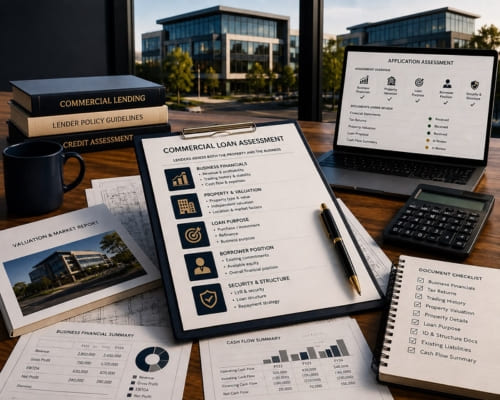
Commercial property finance can take different forms depending on what you’re purchasing, how the property will be used and your business or investment objectives. We compare commercial lending options from 30+ lenders for purposes such as purchasing an owner-occupied commercial property, acquiring an investment property, refinancing existing commercial debt or funding other business purposes, depending on the loan structure and lender requirements. We consider factors including the property type, loan purpose, deposit or available equity, business position, income and proposed loan structure before comparing suitable options. Whether you’re purchasing commercial property in Westmeadows, Broadmeadows or Craigieburn, elsewhere in Melbourne or across Australia, we can help you understand the finance options available for your circumstances. Commercial lending can differ significantly from residential lending, including the way lenders assess the property, business and overall application. Our role is to help you understand those differences, compare suitable lending options and consider the costs and features of each loan before you decide how to proceed.
Loan Point Solutions
How Commercial Lending Is Assessed
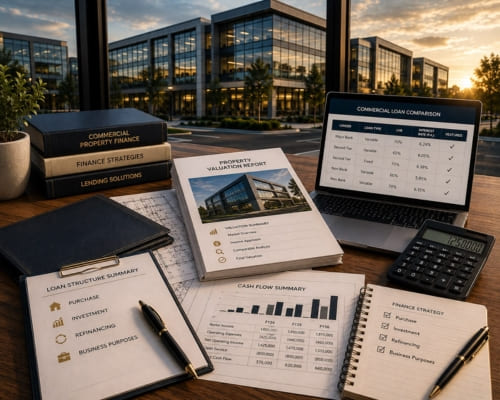
Commercial lending is assessed differently from a standard home loan because lenders may consider both the property and the business or investment behind the application. Depending on the loan purpose, they may look at the property type and value, proposed use, rental income, business financials, trading history, existing commitments, available equity and the borrower’s overall financial position. The level of documentation and assessment can also vary between lenders and loan structures. At Loan Point Solutions, we take the time to understand the full application before comparing suitable options from our lender panel. Whether your business operates in Essendon, Pascoe Vale or Moonee Ponds, elsewhere in Melbourne or across Australia, we can help you understand what lenders may consider and what information may be required. Commercial lending decisions depend on the individual lender’s criteria and the circumstances of the application, so we focus on explaining the process clearly and helping you compare options before you commit to a particular loan.
Loan Point Solutions
Why Businesses Choose Loan Point Solutions
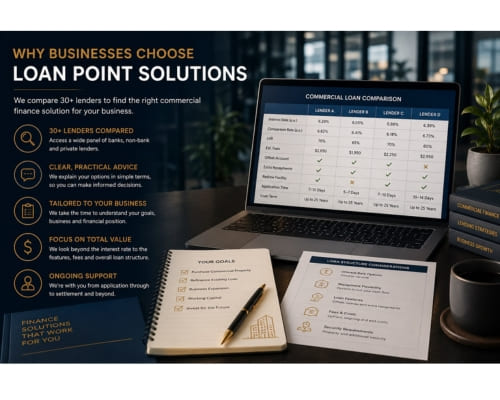
Commercial finance can involve more complex lending decisions, particularly when the loan is connected to a business, commercial property or investment strategy. At Loan Point Solutions, we start by understanding what you are trying to achieve, your current financial position and the proposed property or transaction before comparing suitable options from 30+ lenders. We explain the differences between lender types, loan structures, rates, features and costs in straightforward language, helping you understand what you are considering rather than simply focusing on one headline rate. Whether you’re seeking commercial finance in Sunbury, Craigieburn or elsewhere in Melbourne or across Australia, we provide a practical approach to comparing available lending options. Our role is to help you understand the finance and make an informed decision based on your circumstances and objectives. We do not promise approval, specific rates or business outcomes, because commercial lending depends on the lender, transaction and information available at the time of assessment.
Loan Point Solutions
The True Cost of Commercial Finance
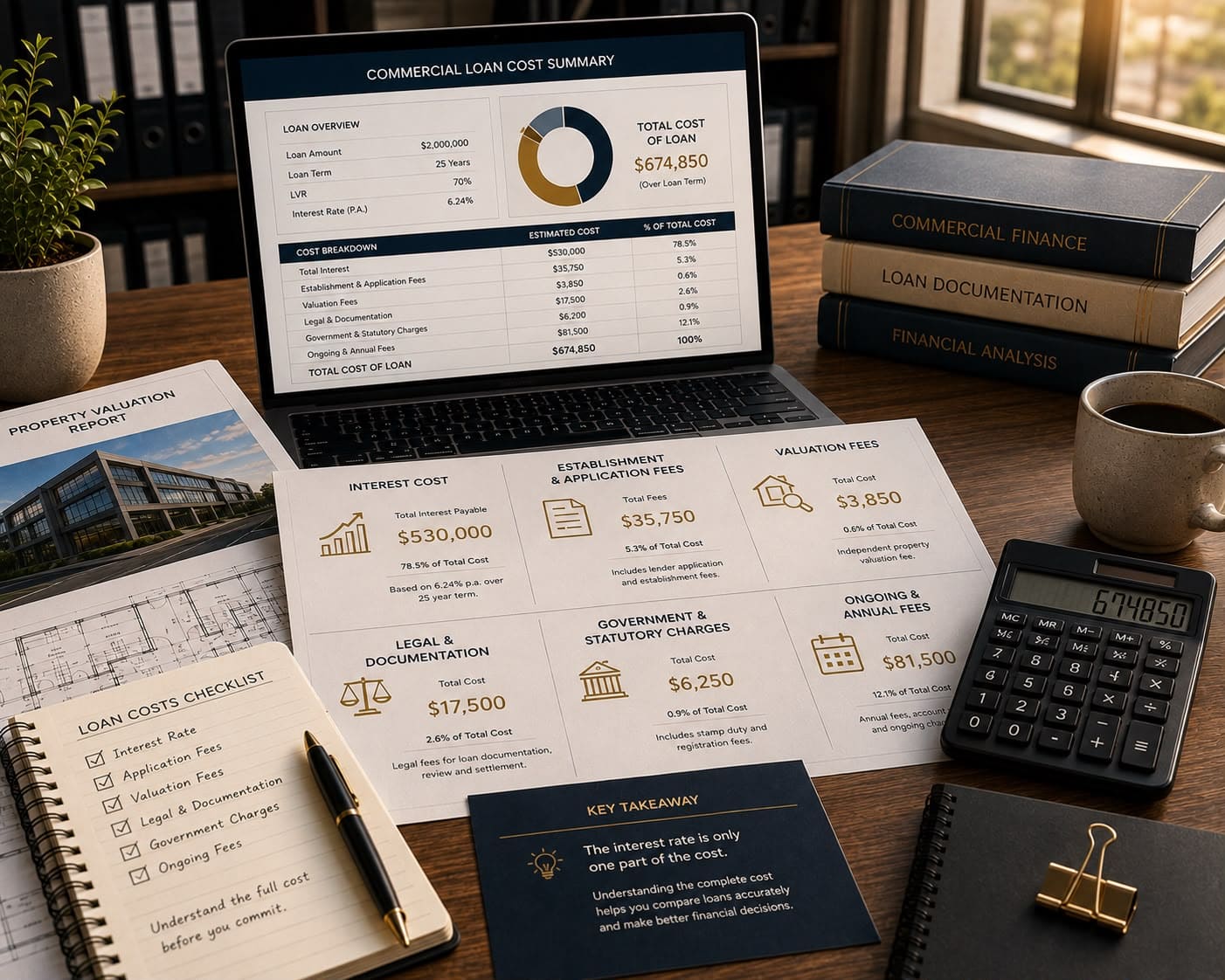
The cost of commercial finance can include more than the interest rate attached to the loan. Depending on the transaction, you may need to consider lender establishment or application fees, valuation costs, legal and documentation expenses, government charges, ongoing account fees and other costs associated with the property or loan structure. Interest rates and fees can also vary between lenders, loan purposes, security types and borrower circumstances. Whether you’re arranging commercial finance in Coburg, Epping or surrounding Melbourne suburbs, or elsewhere across Australia, we can help you understand the costs that may apply to the lending options being considered. We look at the overall loan structure rather than focusing on a single advertised rate, helping you compare the relevant features, fees and repayment considerations. Commercial property and business transactions can also involve costs outside the loan itself, so it is important to consider the broader transaction before making a decision.
Loan Point Solutions
Choosing Between Major Banks, Second-Tier and Private Lenders
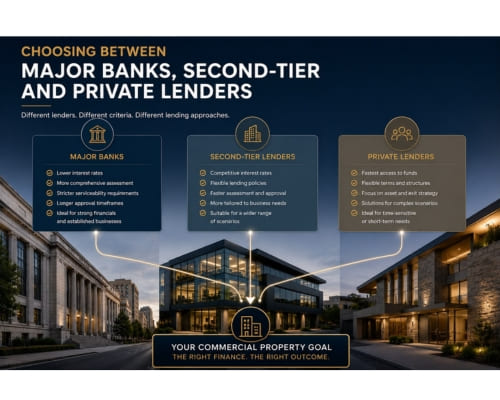
Commercial borrowers may have access to different types of lenders, including major banks, second-tier lenders and private lenders. Each lender type can have different lending policies, assessment processes, loan structures, pricing and requirements, so the most appropriate option depends on the circumstances of the transaction. Major banks may suit some established borrowers and straightforward applications, while second-tier lenders can provide different lending approaches for certain situations. Private lenders may also be considered where a transaction requires a different structure or timeframe, subject to their criteria and costs. Whether you’re considering commercial finance in Westmeadows, Broadmeadows or elsewhere in Melbourne or across Australia, Loan Point Solutions can compare suitable options from our lender panel and explain the differences between them. We consider the purpose of the loan, property, financial position, available security and other relevant factors before helping you understand the available pathways. The goal is not to favour one lender type, but to identify options that may suit your circumstances.
RELATED FINANCE SOLUTIONS


Whether you’re starting, expanding or managing your business, we compare business loan options from 30+ lenders to help identify a solution suited to your circumstances. Based in Melbourne, we assist businesses across Melbourne and Australia-wide.
Whether you’re purchasing commercial property, expanding your business or refinancing existing debt, we compare options from 30+ lenders to help find a loan suited to your circumstances and goals. Based in Melbourne, we assist businesses across Melbourne and Australia-wide.
TESTIMONIALS
What Our Commercial Loans Customers Say About Us
The Process
3 Step Process For Your Commercial Loans Needs

Strategy Call
Tell us your goal, income type and timeframe. We map your borrowing position honestly before you fall in love with a property.

We Structure
We match your income and deposit to the lenders whose policy actually fits, then package and submit the application properly the first time.

Through Settlement
You get updates at every milestone, not silence. We chase the lender, manage conditions, and stay with you after settlement for annual reviews.
Commercial Loans In Westmeadows
FREQUENTLY ASKED QUESTIONS
Everything you need to know about our Commercial Loans In Westmeadows
How much deposit do I need for a commercial loan?
More than residential, and how much more depends on the property type and the tenant. Most lenders sit around 65 to 70 per cent of the property value for standard commercial security, meaning a deposit of 30 to 35 per cent, though owner-occupiers with strong trading figures can sometimes reach 75 or occasionally 80 per cent. Specialised properties such as service stations, childcare centres, hotels and single-purpose buildings attract lower ratios again, sometimes 50 to 60 per cent, because the lender is thinking about how easily the asset could be resold. There is no equivalent of lenders mortgage insurance in commercial, so the deposit requirement is firm rather than negotiable with an insurance premium. Many clients use equity in a residential property to bridge the gap, which we can structure without cross-securing everything.
What is a commercial loan and how is it different from a home loan?
A commercial loan is finance secured against a property used for business rather than residential purposes, such as a warehouse, factory, shop, office or medical suite. Four things differ from a home loan. The loan-to-value ratio is lower, commonly 65 to 70 per cent rather than 80 to 95 per cent. The term is shorter, typically 15 to 20 years and sometimes with a review or balloon at three to five years, rather than a straight 30. Servicing is often assessed on the lease and the business's trading figures rather than a payslip. And pricing is negotiated per deal rather than taken from a rate sheet, so two borrowers can receive quite different terms on similar properties. That last point is why comparing lenders matters far more in commercial than in residential.
What does a commercial loan cost to arrange, including your fee?
Commercial is where a broker fee-for-service genuinely applies, and we disclose it in writing before starting. Depending on the complexity and size of the facility, that fee is commonly in the range of $1,500 to $5,000, or a percentage of the facility on larger or more complex transactions, and it is always agreed with you in advance. The lender's costs are separate and larger: an establishment fee commonly running from around 0.25 per cent up to 1.0 per cent or more of the facility amount, a commercial valuation typically $1,000 to $3,000 and considerably more on larger or specialised assets, and legal and documentation fees usually $1,500 to $3,000 because commercial security documents are prepared by the lender's solicitors. Annual line or review fees are also common. These are indicative market ranges rather than a quote.
How long does a commercial loan take to settle?
Longer than residential, and the range is wide. A straightforward owner-occupied purchase with clean financials through a major bank commonly runs six to ten weeks from application to settlement. More complex transactions, unusual security, or a private funder can be faster or slower depending on which constraint is binding. The parts that take time are the commercial valuation, which is a full inspection and detailed report rather than an automated estimate, the lender's credit assessment which is manual rather than automated, and the preparation and signing of security documents by the lender's solicitors. If you are buying at auction or under a tight settlement, tell us the date at the outset, because it changes which lenders are realistic.
How do you choose between a bank, a second-tier lender and a private funder?
It comes down to which constraint matters most for your deal. A major bank generally offers the sharpest pricing and the longest terms, but wants the strongest financials, the most conventional security and the most time. A second-tier or non-bank lender takes a more flexible view of trading history, lease profile and property type, moves faster, and prices somewhat above the banks. A private funder is fastest and most flexible of all, will consider security and situations the others will not, and is materially more expensive, so it suits short-term or transitional situations rather than long-term holds. We will usually present two options from different tiers with the real cost difference laid out, rather than pushing a single answer.
What happens if my tenant's lease expires during the loan term?
This is the risk lenders think about most on an investment commercial deal and it is worth understanding before you buy. If servicing is assessed on the lease, a lease expiring inside the loan review period weakens the file, and lenders will look closely at the remaining term, the options to renew, the tenant's covenant strength and how easily the space could be re-let. A property with two years left on a lease and no options is a very different proposition to one with five years plus two five-year options. If the lease does expire and the property sits vacant, you carry the repayments from your own resources, and at review the lender may reassess the facility. We factor lease expiry into the structure at the outset, including matching the review period sensibly against the lease term.
Request A Free Commercial Loans Quote
GET A FREE CONSULTATION
BUSINESS
SERVICES
SERVICE AREAS
OPERATING HOURS
Sun: 9:00am - 9:00pm
Mon: 9:00am - 9:00pm
Tue: 9:00am - 9:00pm
Wed: 9:00am - 9:00pm
Thu: 9:00am - 9:00pm
Fri: 9:00am - 9:00pm
Sat: 9:00am - 9:00pm
CRN: 580515
ABN: 72 699 469 228