
CONSTRUCTION LOANS
Build Your Future
With the Right Loan
Finance Your Build With Confidence.
Whether you're building your first home or an investment property, we compare construction loan options from 30+ lenders to find a solution suited to your circumstances. We consider your land, building contract, deposit and project costs. Based in Melbourne's northern suburbs, we assist clients across Melbourne and Australia-wide.
GET A FREE CONSULTATION
Loan Point Solutions
Construction Projects We Can Help Finance

Construction finance can be used for a range of residential building projects, and the right loan structure depends on what you are planning to build. This may include building your first home, purchasing land and building, constructing an investment property or completing a knockdown rebuild. Some borrowers may also require finance for substantial renovations, depending on the scope of the project and lender criteria. At Loan Point Solutions, we consider your land, building contract, deposit, income, existing commitments and expected construction costs before comparing suitable options from our lender panel. Whether you’re building in Gladstone Park, Attwood, Tullamarine or Meadow Heights, we can help you understand the lending requirements associated with your project. Based in Melbourne, we assist clients across Melbourne and Australia-wide, with guidance tailored to your circumstances and the type of construction project you are undertaking. Our aim is to help you understand your finance options before committing to your build.
Loan Point Solutions
How Construction Loan Progress Payments Work — And Where They Can Stall
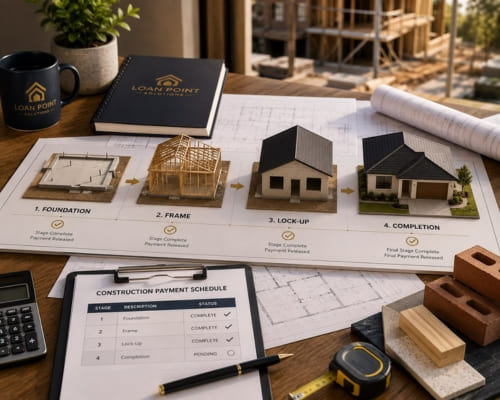
Construction loans generally work differently from standard home loans because funds are released progressively as your build reaches agreed stages. These payments, often called progress payments or drawdowns, allow the lender to release funds to the builder as work is completed and relevant requirements are met. The exact process can vary between lenders and building contracts, including requirements for invoices, inspections, valuations and supporting documents. Delays can sometimes occur when requested documentation is incomplete, construction stages have not been completed or changes to the original building contract need to be reviewed. At Loan Point Solutions, we help you understand the proposed loan structure and lender requirements before construction begins. Whether you’re building in Broadmeadows, Roxburgh Park or Greenvale, we can help you prepare for the funding process. Based in Melbourne, we assist clients across Melbourne and Australia-wide, providing practical guidance throughout your construction loan application.
Loan Point Solutions
Understanding the Costs Beyond the Build
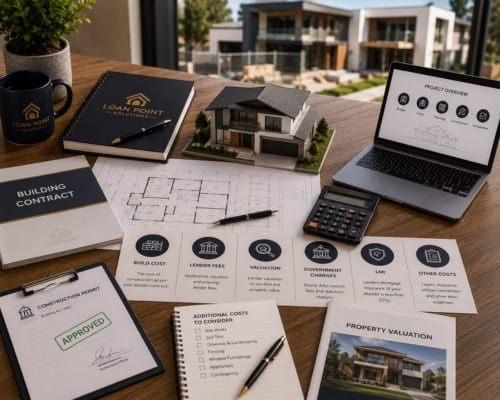
The cost of a construction project can extend beyond the amount quoted by your builder. Depending on your circumstances and the loan you choose, you may also need to consider lender fees, valuation costs, government charges, conveyancing, Lenders Mortgage Insurance (LMI) where applicable and other property-related expenses. Additional project costs may include design, permits, site preparation, landscaping or variations to the original building scope. Understanding these costs early can help you determine the funding required and how they may affect your overall budget. At Loan Point Solutions, we consider the broader costs of your project when comparing suitable construction loan options from our lender panel. Whether you’re building in Westmeadows, Gladstone Park or Attwood, we can help you understand the potential costs associated with your finance and construction plans. Based in Melbourne, we assist clients across Melbourne and Australia-wide, helping you make a more informed decision before proceeding with your project.
Loan Point Solutions
House and Land, Knockdown Rebuild or Renovation
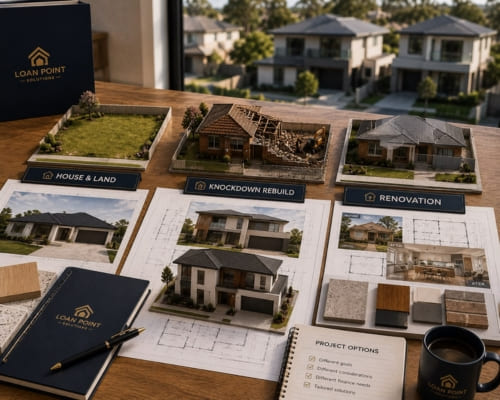
The finance requirements for a house-and-land package, knockdown rebuild or major renovation can differ depending on the property, project structure and lender criteria. With a house-and-land package, you may need to consider the purchase of the land and construction component together. A knockdown rebuild involves an existing property, demolition and construction of a new home, while major renovations may require finance based on the scope of work and expected value of the completed property. At Loan Point Solutions, we consider your project, financial position and lending requirements before comparing suitable options from our lender panel. Whether you’re planning a knockdown rebuild in Tullamarine, a house-and-land purchase in Meadow Heights or a major renovation in Broadmeadows, we can help you understand the relevant finance considerations. Based in Melbourne, we assist clients across Melbourne and Australia-wide, with practical guidance tailored to your project, borrowing position and longer-term goals.
Loan Point Solutions
Why Builders and Buyers Choose Loan Point Solutions
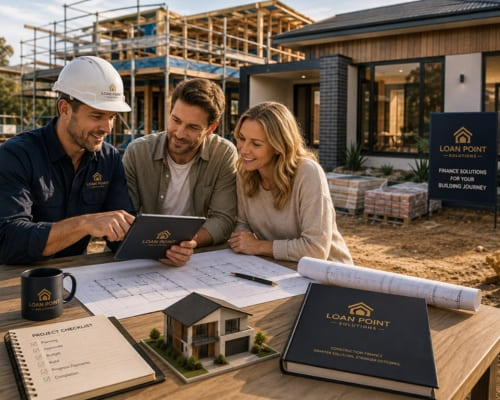
Construction finance can involve more moving parts than a standard home loan, from building contracts and valuations to progressive drawdowns and changing project costs. Working with a mortgage broker can help you compare lender policies and understand how different construction loan requirements may apply to your project. At Loan Point Solutions, we compare suitable construction loan options from our lender panel and consider lender criteria, fees, loan features and overall suitability rather than focusing only on the advertised interest rate. We take the time to understand your income, deposit, existing commitments, building plans and expected project costs before helping you assess your options. Whether you’re building in Jacana, Coolaroo, Dallas or Campbellfield, we provide a convenient point of contact for your lending needs. Based in Melbourne, we assist clients across Melbourne and Australia-wide, providing practical guidance and clear communication throughout the application process and construction journey.
RELATED FINANCE SOLUTIONS
Explore our other lending solutions designed to support your property, investment and business goals

Build your property portfolio with the right finance.
For purchasing your first investment property, expanding an existing portfolio or using available equity, we compare suitable investment loan options based on your circumstances and goals.

Review your current loan and explore your options.
Whether you’re looking for a more competitive rate, better loan features or a different structure, we compare refinancing options and help you understand the potential benefits and costs of switching.
Finance your next business opportunity with confidence
From working capital and expansion to business purchases and other funding needs, we compare suitable finance options based on your business position and objectives.
TESTIMONIALS
What Our Construction Loans Customers Say About Us
The Process
3 Step Process For Your Construction Loans Needs

Strategy Call
Tell us your goal, income type and timeframe. We map your borrowing position honestly before you fall in love with a property.

We Structure
We match your income and deposit to the lenders whose policy actually fits, then package and submit the application properly the first time.

Through Settlement
You get updates at every milestone, not silence. We chase the lender, manage conditions, and stay with you after settlement for annual reviews.
Construction Loans In Westmeadows
FREQUENTLY ASKED QUESTIONS
Everything you need to know about our Construction Loans In Westmeadows
How much deposit do you need for a construction loan in Australia?
Broadly the same as a standard home loan, though the calculation is different because the lender assesses the land and build together. Most lenders will go to 90 or 95 per cent of the total on-completion value with lenders mortgage insurance applying above 80 per cent, so 5 to 10 per cent plus costs is often workable and 20 per cent avoids the insurance. What differs is that the lender values the finished property based on your plans and fixed-price contract, then lends against that on-completion figure, so a strong contract price relative to the valuation improves your position. On house-and-land in the growth corridor you also often need to settle the land first and start the build afterwards, which changes when your deposit is actually required.
Who is eligible for a construction loan?
The applicant tests are the same as any home loan, covering income, commitments and credit history, but there are additional requirements attached to the build itself. Lenders generally require a fixed-price building contract with a registered builder, council-approved plans and permits, and domestic building insurance in place. The builder needs to be appropriately registered and, with some lenders, will be checked. Owner-builders are a different category entirely and only a limited number of lenders will consider them, usually at a lower loan-to-value ratio and with additional evidence required. If you are considering owner-building, tell us at the outset because it narrows the lender field substantially and changes the deposit you will need.
How do the progress payments actually work?
The loan is released in stages matched to the build, most commonly five: the base or slab stage, frame, lock-up, fixing, and practical completion. Your builder issues an invoice at each stage, you authorise it, the lender sends a valuer to confirm that stage of work is genuinely complete, and the funds are then released directly to the builder. You pay interest only on the amount drawn to date, so your repayments start small and step up as the build progresses. Once the final payment is made, the loan converts to a standard principal and interest home loan over the remaining term. The friction point is usually the valuation inspection, which is why we push the request through the moment your builder invoices rather than at the end of the week.
How long does a construction loan take to arrange and to run?
Approval typically takes two to four weeks, a little longer than a standard home loan because the lender also assesses the building contract, plans and permits. The build itself is where the real timeline sits, and a standard single-storey home commonly runs nine to fifteen months from slab to handover, with delays from weather, trade availability and material supply being routine rather than exceptional. Each progress draw needs three to five business days from invoice to payment once the valuer has attended. Budget for holding costs across that whole period, because you are usually paying rent as well as loan interest until you can move in.
Should I have you review my building contract before I sign it?
Yes, and it is free. A fixed-price contract that does not meet lender requirements is one of the most common causes of a construction file stalling, and the problems are almost always fixable before signing and painful afterwards. We check that the contract is genuinely fixed price rather than cost-plus, that the progress payment schedule matches what lenders will fund, that the stages and percentages are conventional, and that site costs, driveways, landscaping, fencing and floor coverings are either included or clearly identified as out-of-contract items you will need separate funds for. Out-of-contract items are the single biggest source of budget shock on a new build, because lenders will not fund what is not in the contract.
What if the on-completion valuation comes in below the contract price?
This is the main risk in construction lending and it is worth planning for. The lender lends against the on-completion valuation, so if that figure lands below your land price plus build cost, you have to cover the shortfall from your own funds, accept a higher loan-to-value ratio with lenders mortgage insurance, or move the file to a lender using a different valuer. It happens most often in growth-corridor estates where a lot of similar stock is being completed at once, and on builds with high-specification inclusions that do not lift the valuation proportionally. Raising it early gives you options; discovering it at lock-up stage does not. We flag the risk before you sign wherever the numbers look tight.
Request A Free Construction Loans Quote
GET A FREE CONSULTATION
BUSINESS
SERVICES
SERVICE AREAS
OPERATING HOURS
Sun: 9:00am - 9:00pm
Mon: 9:00am - 9:00pm
Tue: 9:00am - 9:00pm
Wed: 9:00am - 9:00pm
Thu: 9:00am - 9:00pm
Fri: 9:00am - 9:00pm
Sat: 9:00am - 9:00pm
CRN: 580515
ABN: 72 699 469 228